
The CBSE second board exam is an important change in the Class 10 examination system introduced by the Central Board of Secondary Education (CBSE). The new system gives eligible students an additional opportunity to improve their academic performance without waiting for another academic year.
For students and parents, understanding the CBSE second board exam is important because the examination has specific rules related to eligibility, subjects, improvement, preparation, and results. Instead of treating the second examination as simply another attempt, students should understand how the system works and how they can use the opportunity effectively.
In this guide, we will explain the CBSE second board exam, its purpose, eligibility, subjects, preparation strategy, important rules, and other key details that Class 10 students should know.
What Is the CBSE Second Board Exam?
The CBSE second board exam is the second Class 10 Board Examination conducted under CBSE’s two-board-examination system.
Under this system, students appear for the first Board Examination, while eligible students get an opportunity to improve their performance through the second Board Examination. CBSE introduced this system from the 2026 examination cycle as part of its efforts to reduce the pressure associated with a single high-stakes Board Examination.
The CBSE second board exam is particularly useful for students who believe they can improve their marks in selected subjects after appearing for the first examination.
It also gives students another opportunity to demonstrate their knowledge and improve their academic record within the same academic examination cycle.
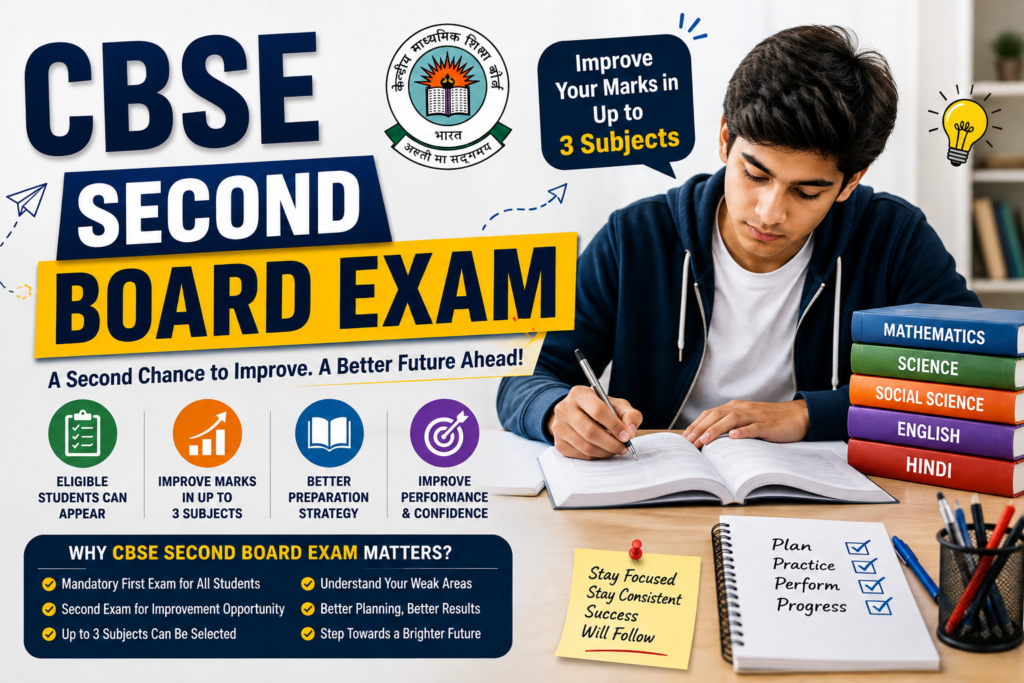
Why Did CBSE Introduce Two Board Exams?
The introduction of the CBSE second board exam is connected with the broader objective of making Board Examinations more flexible and less stressful for students.
A single examination can create significant pressure because students may have limited opportunities to recover from poor performance caused by examination anxiety, illness, preparation problems, or unexpected difficulties.
With the two-examination structure, students can have an additional opportunity to improve their performance.
The basic idea is not to encourage students to take examinations casually. Instead, the CBSE second board exam provides an additional pathway for eligible students who want to improve their results.
This approach can also encourage students to focus on learning and preparation instead of considering one examination as their only opportunity to demonstrate their ability.
Is the CBSE Second Board Exam Compulsory?
One of the most common questions among students is whether the CBSE second board exam is compulsory.
The first Board Examination is mandatory for Class 10 students. The second examination is intended as an opportunity for eligible students, particularly those who want to improve their performance.
Therefore, students should not assume that everyone must appear for both examinations.
However, eligibility and subject-related conditions can apply. Students should always check the latest official CBSE notification and instructions provided by their school before making decisions about the second examination.
Who Can Appear for the CBSE Second Board Exam?
The eligibility rules for the CBSE second board exam are important because not every student can automatically select any subject for the second examination.
According to CBSE’s two-board examination framework, eligible students who have passed can use the second examination as an improvement opportunity in up to three subjects.
Students should carefully check the applicable CBSE rules for their examination year because eligibility conditions and administrative procedures can be updated.
The school is also an important source of information because students generally need to follow the prescribed registration and examination procedures.
How Many Subjects Can Students Improve?
A major advantage of the CBSE second board exam is the opportunity to improve performance in selected subjects.
Eligible students can improve their performance in up to three subjects, according to the CBSE framework.
This means students do not necessarily have to repeat every subject. Instead, they can focus their preparation on the subjects where they believe a significant improvement is possible.
For example, a student who performed well in English and Social Science but received lower marks in Mathematics, Science, and another eligible subject may focus on those areas.
The exact subjects and conditions should be confirmed through the latest CBSE notification.
Which Subjects Are Included?
The CBSE second board exam covers eligible Class 10 subjects according to CBSE’s examination framework.
Depending on the student’s subject combination, this can include subjects such as:
- Mathematics
- Science
- Social Science
- English
- Hindi
- Other eligible languages
- Other subjects specified by CBSE
Students should not select subjects based only on general information available online. Their subject combination, eligibility, and registration status should be checked with their school and the latest CBSE instructions.
CBSE First Board Exam vs Second Board Exam
Understanding the difference between the two examinations can help students plan properly.
| Feature | First Board Examination | Second Board Examination |
|---|---|---|
| Main purpose | Primary Board Examination | Improvement opportunity |
| Students | Class 10 students | Eligible students |
| Requirement | Mandatory | For eligible students |
| Improvement | Initial result | Opportunity to improve |
| Subject selection | According to Board subjects | Up to three eligible subjects |
| Preparation | Full examination preparation | Targeted improvement preparation |
The CBSE second board exam should therefore be viewed as an opportunity rather than simply a repeat examination.
How Should Students Prepare for the CBSE Second Board Exam?
Preparation for the CBSE second board exam should be more targeted than general Board preparation.
Students already have useful information from their first examination. They know which chapters were difficult, which questions caused problems, and where they lost marks.
1. Analyse Your First Examination
The first step is to identify the reason behind your marks.
Ask yourself:
- Which chapters were difficult?
- Which concepts were unclear?
- Did you make calculation mistakes?
- Did you lose marks because of incomplete answers?
- Did you have difficulty managing time?
- Were there questions you understood but could not answer correctly?
This analysis can make preparation for the CBSE second board exam much more effective.
2. Focus on Weak Topics
Do not spend equal time on every chapter.
Identify your weakest topics and give them more attention. Once the difficult areas become stronger, revise the topics you already understand.
This approach helps students use their preparation time efficiently.
3. Practise CBSE Question Papers
Question-paper practice is one of the most useful ways to prepare for the CBSE second board exam.
Students should solve official question papers under timed conditions. After completing a paper, check the answers and identify mistakes.
Do not simply count the marks. Understand why marks were lost.
4. Study the Marking Scheme
The CBSE marking scheme can help students understand how answers are evaluated.
For subjects such as Science, Mathematics, and Social Science, knowing how marks are distributed can help students structure their answers more effectively.
Students should use the official marking scheme wherever available instead of depending entirely on unofficial answer keys.
5. Improve Answer-Writing Skills
Getting the correct answer is important, but presenting it properly also matters.
Students should practise:
- Writing clear answers
- Showing relevant steps
- Using appropriate terminology
- Including important points
- Drawing labelled diagrams where required
- Avoiding unnecessary information
Good answer presentation can make a difference when students are trying to improve their marks.
How Can Students Manage Time During Preparation?
Time management is another important part of CBSE second board exam preparation.
Students should create a realistic study schedule based on their selected subjects.
A useful daily structure can include:
Concept Revision → Question Practice → Mistake Analysis → Quick Revision
Instead of studying for extremely long hours, focus on productive sessions with regular breaks.
Students should also reserve time for mock tests because solving papers under examination conditions is different from simply reading chapters.
Common Mistakes to Avoid
Students preparing for the CBSE second board exam should avoid several common mistakes.
Studying Everything From the Beginning
If your main goal is improvement in selected subjects, completely restarting every chapter may waste valuable time.
Focus first on weak areas.
Ignoring Previous Mistakes
Your first examination provides valuable feedback. If you make the same mistakes again, the second opportunity may not produce the improvement you expect.
Only Reading Instead of Practising
Reading textbooks is useful, but students also need to solve questions.
Practice helps identify gaps that may not be obvious during passive reading.
Depending Only on Guess Papers
Guess papers can be used for additional practice, but students should prioritize the official syllabus, textbooks, question papers, and marking schemes.
Ignoring Time Management
A student may know the answers but still lose marks if the paper is not completed properly.
Timed practice should therefore be part of preparation for the CBSE second board exam.
CBSE Second Board Exam Date Sheet and Admit Card
CBSE releases official examination information through its official channels.
The date sheet, admit card instructions, examination notices, and other information can change depending on the examination year.
For the 2026 examination cycle, CBSE released official information related to the Class X Second Board Examination, including the date sheet and admit-card updates.
Students should avoid relying on old social-media posts or outdated websites when checking examination dates.
Always verify the latest information through CBSE and your school.
CBSE Second Board Exam Result
The result is another important part of the CBSE second board exam process.
For students appearing to improve their performance, the result provides information about their performance in the second examination.
Students should carefully check the official result information and understand how the applicable improvement rules affect their final academic record.
For the 2026 examination cycle, CBSE officially announced the Class X Second Board Examination result on 18 July 2026.
Future examination dates and result announcements may differ, so students should check the latest CBSE notification for their examination year.
Tips for Scoring Better in the CBSE Second Board Exam
If you want to maximize your improvement, follow a focused strategy.
Make a Mistake Notebook
Write down:
- Incorrect answers
- Difficult formulas
- Important concepts
- Frequently repeated mistakes
- Questions requiring additional practice
Review this notebook regularly.
Practise Full-Length Papers
Try to complete complete papers within the prescribed time.
After every paper, analyse your performance rather than simply looking at your score.
Revise Regularly
Short and frequent revision sessions can help retain important concepts.
Ask Teachers for Feedback
Your teachers can identify weaknesses that you may not notice yourself.
Ask them to check your answers and explain where you can improve.
Stay Consistent
The CBSE second board exam is an opportunity, but the result still depends on preparation.
A consistent study routine is more effective than last-minute preparation.
Is the Second Board Exam a Second Chance?
For eligible students, the CBSE second board exam can effectively provide another opportunity to improve performance.
However, students should not treat it as a reason to reduce their effort during the first examination.
The best strategy is to prepare seriously for the first Board Examination and then use the second examination, where eligible, as an opportunity to improve specific subjects.
This approach provides students with two advantages: strong preparation for the main examination and a focused improvement strategy if another attempt is appropriate.
Final Thoughts
The CBSE second board exam represents a significant change in the Class 10 examination system. It provides eligible students with an additional opportunity to improve their performance in selected subjects.
Students can make the most of this opportunity by analysing their first examination, identifying weak areas, practising official question papers, understanding marking schemes, and improving answer-writing skills.
Most importantly, students should always verify eligibility, subject rules, registration requirements, examination dates, and result information through official CBSE notifications and their school.
The CBSE second board exam should not be seen as an easy alternative to preparation. Instead, it should be treated as a focused opportunity to learn from previous mistakes, strengthen weak areas, and demonstrate improved performance.
Frequently Asked Questions
What is the CBSE second board exam?
The CBSE second board exam is the second Class 10 Board Examination under CBSE’s two-board examination system. It provides eligible students with an opportunity to improve their performance.
Is the CBSE second board exam compulsory?
The first Board Examination is mandatory. The Second Board Examination is intended as an opportunity for eligible students and is not simply compulsory for every student.
How many subjects can I improve?
Eligible students can improve their performance in up to three subjects under the applicable CBSE rules.
Can I improve my Class 10 marks?
Yes. The CBSE second board exam provides an improvement opportunity for eligible students in permitted subjects.
How should I prepare for the second Board Exam?
Analyse your first examination, identify weak areas, revise concepts, practise official question papers, study marking schemes, and complete timed mock tests.
Where can I find official information?
Students should use the official CBSE website and information provided by their school for the latest examination notifications, dates, rules, question papers, and marking schemes.
Conclusion
The CBSE second board exam gives eligible Class 10 students an additional opportunity to improve their academic performance. With focused preparation and proper analysis of the first examination, students can use this opportunity effectively.
Rather than studying randomly, identify your weaknesses, practise consistently, understand the marking scheme, and follow the latest official CBSE guidelines. A strategic approach can make your preparation more productive and help you perform with greater confidence in the CBSE second board exam.
Author Bio
Ajay Kataria is the founder and experienced CBSE educator at Ajay Kataria Classes (AKC Classes), a trusted coaching institute in West Delhi. With years of experience in CBSE coaching and academic guidance, he focuses on helping students build strong concepts, improve their exam preparation, and achieve better academic results.
Through AKC Classes West Delhi, Ajay Kataria provides expert guidance for CBSE students with a student-focused approach, structured learning, regular practice, and personalised academic support. His teaching philosophy focuses on conceptual clarity, consistent preparation, and developing confidence in students.
Expertise: CBSE Coaching, Class 10 & 12 Preparation, Academic Guidance, Exam Preparation, and Student Mentorship.